
Introduction
On this page the project team exhibits images representing the research processes during various phases of the project life-cycle. The images were taken by a variety of participants, none of whom have received formal photography training. The purpose here is to tell the story of the investigation through the eyes of the participants during during the stages of the project’s life-cycle. If you wish to get a better understanding of each stage represented here, you can do so by reading across the other related areas of the blog, e.g., the methodology menu describes the process of each stage in more detail and should provide context for each section represented below. Please note that the images shown in the galleries below are thumbnails and show a portion of each image. If you wish to see the complete image, you can click on it.
Project Planning Meeting – August 2018
Community Conversations – January 2019
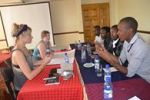
Students and staff from Rongo University and the University of Brighton meet to plan and discuss the days events – who we are going to see; what we hope to achieve and why? We outline the community conversations approach with the Sub-Location Area Chief and community representatives in Cham gi wadu; staff from Omware Secondary School and women groups representatives at Oyora market. Students were given a break before lunch, after which we departed for our first stop at Cham gi wadu.
Preparing the day ahead
Community conversation at Chief’s Offices in Cham gi wadu
We arrived to a warm and friendly greeting at the Chief’s offices in Cham gi wadu, where the second radio studio is to be built.
-
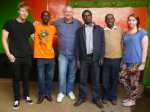
- Callum, Kris, Peter, Mike, Roman & Rosie
-
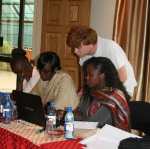
- Callum explains the finer points of blogging
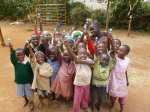
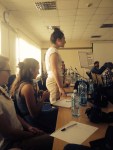
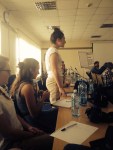
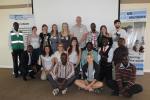
Community conversation with staff at omware secondary school
After leaving the Chief’s offices we moved on to CM4K’s old friends at Omware Secondary School, where discussed if and how the project and the curriculum might prove mutually beneficial.
Conversations with Women’s groups representatives at Oyora Market
The day concluded with a some really interesting discussions with representatives from women’s groups in the region.
Participatory Learning WorksHops (PLWs)
The next 3 galleries present images from the capacity building activities of the 2 types of PLWs we designed and facilitated. The first 2 galleries exhibit pictures from the 2 scenario-based PLWs we facilitated. The third shows images from the community media practice PLW.
Scenario-based PLW #1
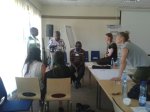
In this workshop, participants were asked to discuss the causes of modern slavery; explore ways in which awareness of these issues might be raised; and consider how it may be addressed within the community. Which agencies might be involved? How could policy administrations assist in these processes and should they?

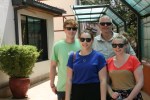
Scenario-based PLW #2
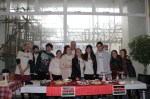
Here the set-up was much the same as PLW #1 only this time, at the request of the participants, the scenario had a community radio flavour to it. In this instance, the scanario was as follows.
You are members of a community radio production team and have been invited by the community to explore ways in which the new community radio station might:
- Help raise awareness of the problems of modern-day slavery in Migori County;
- Campaign to effect social change (what issues need to be covered and how?); and
- Organize content for community campaigns that contribute to solving these problems within the community.
Community media practice PLW
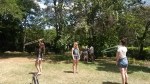
In this gallery we present images from the community radio practice PLW. This was at the request of the community participants, who are working with Community Media 4 Kenya (CM4K) on building a community radio studio in Cham gi wadu. Some of the participants in this workshop participated in the elicitation of community stories in the participatory fieldwork that was to follow.
Story collection – community media-based Participatory fieldwork
From January to April 2021, the Keyan CO-Is and community participants were actively engaged in fieldwork, collecting stories of modern slavery hidden in the community. This gallery communicates various visual representations of those processes.
Local elders at Chief’s barazza
Community health workers & Area chief
Kagan Tradtional dancers
Omware Secondary School – songs & Poems
 Community Media 4 Kenya